Developing a robotic spine surgery platform
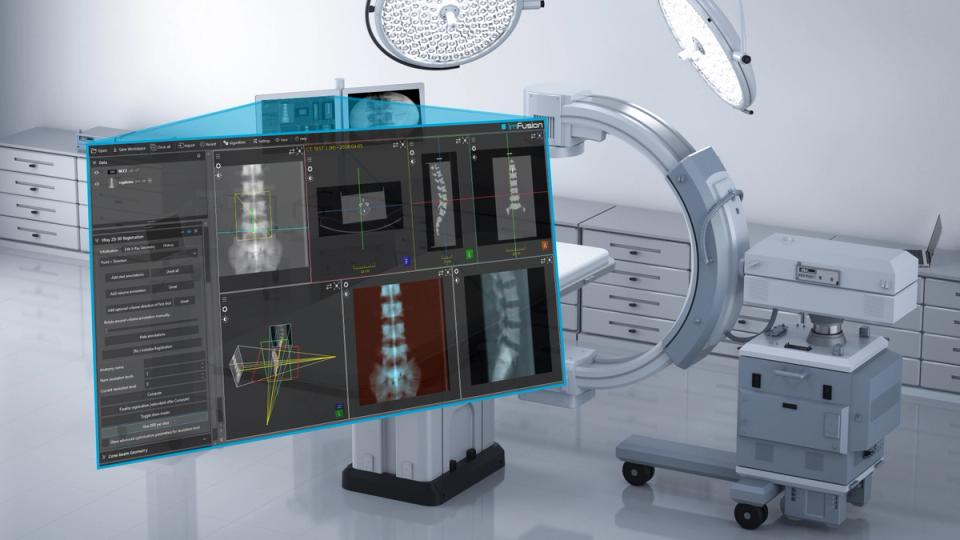
How ImFusion helps medical technology companies turn advanced imaging concepts into integrated capabilities for surgical navigation and robotic assistance.
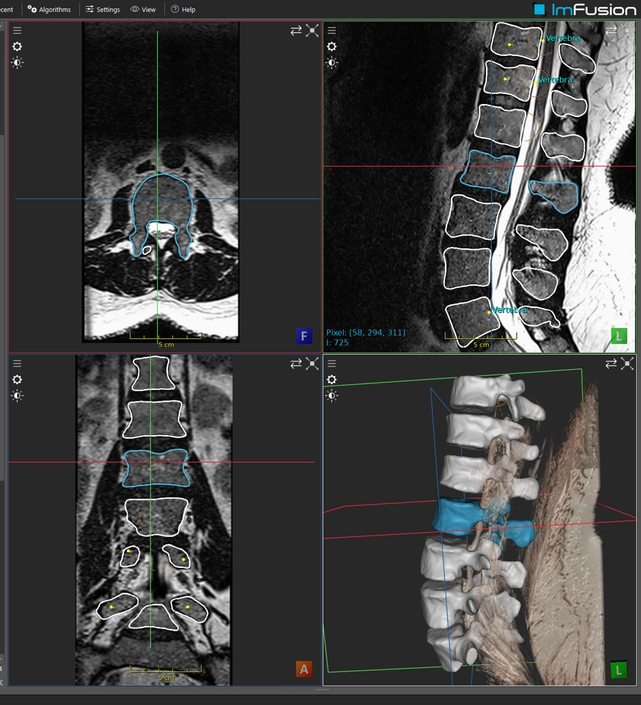
Project overview
This example illustrates how we typically work with companies developing robotic spine surgery systems. Depending on the starting point, we may contribute a focused algorithm, create an imaging prototype, or provide the software foundation for a broader navigation and robotics workflow. Our role can grow as technical requirements, clinical applications, and product generations evolve.
- Project type: Industry collaboration
- Clinical fields: Orthopaedics / spine surgery / cranial surgery / robotic surgery
- Expertise applied: Medical image registration / X-ray 2D/3D registration / 3D visualization / machine learning / anatomical analysis (spine, cranial)
- Project duration: From months to several years
- Project state: Commercial product development
Robotic spine surgery requires a reliable connection between medical imaging and the physical operating room.
The challenge
Modern robotic spine surgery combines pre- and intraoperative imaging, surgical planning, navigation, and robotic assistance to help surgeons accurately place implants and instruments. Images acquired before and during surgery must be interpreted and aligned, anatomical structures must be localized, and the resulting spatial information must be made available to navigation and robotic systems.
- Interpretation of preoperative and intraoperative images
- Alignment of intraoperative X-ray images with 3D patient data
- Consistent spatial information across coordinate systems
- Anatomical analysis and surgical planning
- Real-time integration with navigation and robotic systems
- Product-ready performance, reliability, and maintainability
Our approach
We combine specialized imaging capabilities on a shared software platform instead of developing each function in isolation. This allows customer teams to evaluate registration, anatomical analysis, planning, visualization, and navigation together before deciding how individual components should be integrated into the final product.
- Rapid evaluation using representative clinical data
- Interactive prototypes combining multiple imaging capabilities
- Reusable components built on a common technology base
- Clear interfaces to customer software, devices, and robotic systems
- Progressive maturation from research code to product software
The impact
Advanced navigation and robotics depend on accurate spatial information about the patient, anatomy, instruments, and surgical plan. We provide this imaging foundation while reducing the time and technical risk involved in developing the complete medical imaging stack internally.
- Accelerated access to specialized imaging capabilities
- Faster validation of difficult imaging concepts
- Reduced development effort for foundational technology
- Reuse across product generations and clinical applications
Our process
Explore concrete clinical challenges
We begin with a concrete workflow, dataset, or integration challenge. Together with the customer’s clinical and engineering teams, we clarify the intended use, available imaging data, system architecture, performance requirements, and relevant technical risks.
Prototype on an established platform
Using the ImFusion Suite and SDK, we combine existing capabilities in image processing, registration, anatomical analysis, planning, and visualization. This makes it possible to test different approaches with representative data before committing to a final implementation.
Mature into a commercial platform
Once feasibility has been demonstrated, we refine the selected approach into reliable software components. ImFusion specialists work directly with the customer’s engineers to address imaging quality, geometry, performance, interfaces, testing, and integration into the wider surgical system.
Extend the technology as the platform evolves
New product generations often introduce different imaging devices, robotic systems, anatomical applications, or workflow requirements. A shared technology base allows proven capabilities to be adapted and extended without restarting development from the beginning.
More than an algorithm: a foundation for continuous product development
ImFusion technology
The ImFusion SDK provides a common basis for medical image processing, registration, anatomical analysis, 3D visualization, and navigation. For robotic spine surgery, it can connect 3D patient imaging with intraoperative X-ray data and supply the spatial information required for surgical planning, guidance, and robotic assistance.
ImFusion expertise
Customers gain access to senior specialists in medical imaging, geometry, machine learning, anatomy, registration, visualization, and surgical navigation. Working closely with internal engineering teams, we help solve challenges across the complete imaging chain and bridge the critical gap between exploratory R&D and commercial product development.
We offer two types of introductory calls so we can make sure we’re speaking to the right audience.
Product Demo
In a product demo, we show you how the ImFusion Suite, SDK, and ImFusion Labels support medical imaging and data annotation workflows. We focus on the capabilities relevant to your application and discuss directly how our technology could fit into your product or support your use case.
- See integration points mapped to your specific tech stack
- Identify bottlenecks before committing development resources
- Validate data format compatibility and transformation requirements
- Get immediate answers from engineers who built the system
Discovery Call
In a discovery call, we learn about your clinical or technical challenge and discuss how ImFusion’s expertise and technology could help make your idea a reality. Together, we identify promising first steps and determine where we can add the most value.
- Identify technical risks and regulatory considerations early
- Align engineering, clinical, and business stakeholders quickly
- Get a realistic timeline and resource estimate
- Leave with actionable next steps, not vague promises